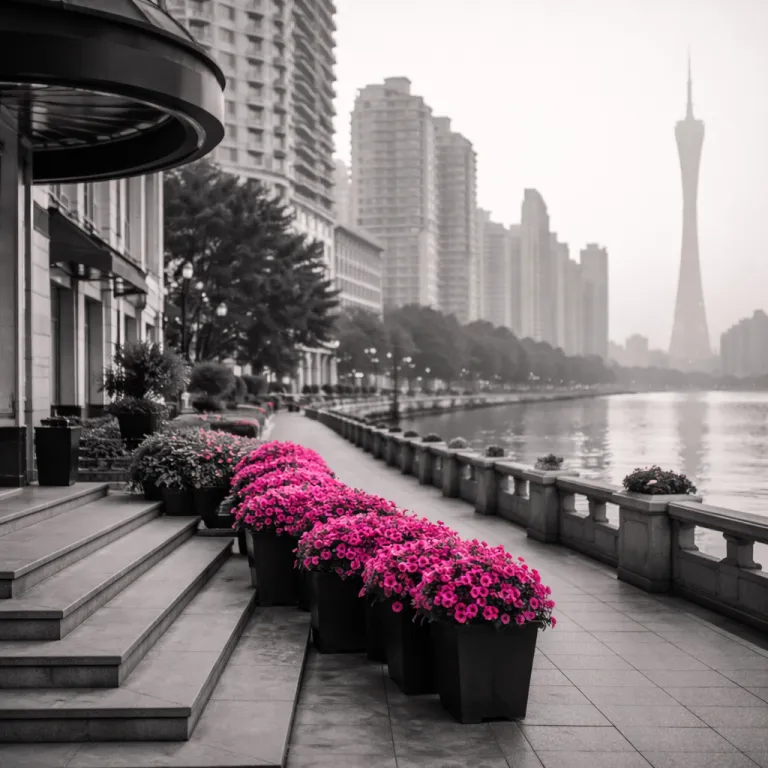
Tianhe district: contemporary Guangzhou in high definition
Glass towers rise above Tianhe Road, catching the humid light that rolls in from the Pearl River. This is the financial and commercial heart of Guangzhou China, and the most natural base if you want a polished, international-style stay. Hotels in Tianhe cluster around Zhujiang New Town and the area between Shipaiqiao and Linhexi metro stations, giving you quick access to the city center, major malls, and the main railway station that connects to Shenzhen and Hong Kong.
Representative Tianhe hotels in Guangzhou include mid-range to luxury options such as Four Seasons Hotel Guangzhou (high-end, Zhujiang New Town, around 40–50 minutes by taxi from Baiyun Airport), Mandarin Oriental Guangzhou (upper-upscale, Taikoo Hui by Shipaiqiao, about 20 minutes to Guangzhou East Railway Station), and Sheraton Guangzhou Hotel (upper-midscale, near Linhexi, roughly 25–35 minutes to the Canton Fair Complex in Haizhu). Budget-conscious travelers often look at Holiday Inn Guangzhou Tianhe (mid-range, Linhexi area, convenient for Guangzhou East in under 10 minutes by car) or nearby business hotels along Tianhe Road.
For many travelers, Tianhe district feels like the “default” choice. Large luxury hotels here tend to offer generous room sizes, well-equipped fitness centers, and often an indoor or outdoor pool tucked high above the traffic. Business travelers appreciate the proximity to corporate offices and exhibition venues, while leisure guests value the ease of moving around town by metro or car. Parking is usually straightforward in this part of Guangzhou, which matters if you are arriving with a driver or renting a car within China.
If you want a hotel Guangzhou experience that feels current and urban, Tianhe delivers. The skyline around Huacheng Square, near the Guangzhou Opera House and the Guangdong Museum, is particularly striking at night. This is also where you will find some of the best Guangzhou hotel collections of suites with river views, club lounges with evening canapés, and refined breakfast spreads that move effortlessly between dim sum, congee, and Western classics. Families who like structure and convenience tend to be happiest here.
- Best for: business trips, first-time visitors, families wanting modern comforts, shoppers
- Typical metro access: Zhujiang New Town, Shipaiqiao, Linhexi on Lines 1, 3, and 5
- Average transfer times: 20–30 minutes to Guangzhou East, 30–45 minutes to the airport, 20–35 minutes to the Canton Fair area
Yuexiu and the old center: history, parks, and a slower rhythm
Red flags flutter above government buildings on Jiefang North Road, while locals practice tai chi under the banyan trees of Yuexiu Park. Staying in Yuexiu places you closer to the historic core of Guangzhou, with its older streets, civic landmarks, and a more traditional rhythm of life. Hotels here often sit near large green spaces or along main arteries that have been central to the city for decades.
Typical Yuexiu accommodation ranges from long-established full-service properties to simpler business hotels. The Garden Hotel Guangzhou (upper-upscale, Taojin metro, about 15 minutes by taxi to Guangzhou Railway Station) is a classic choice with large grounds, while Dongfang Hotel (mid- to upper-midscale, Yuexiu Park station, roughly 20–30 minutes to Guangzhou East) offers easy access to the park and nearby museums. Asia International Hotel (mid-range, Xiaobei station, around 35–45 minutes to the airport) and nearby budget chains along Huanshi East Road give cost-conscious travelers central bases without sacrificing connectivity.
This area suits travelers who want to visit Guangzhou with a sense of continuity and context. You are never far from a garden or park, and morning walks can replace the treadmill in a fitness center. Some long-established hotels in the broader city center have a distinct 1980s or 1990s character: wide marble lobbies, generous ballrooms, and room layouts that prioritize space over design theatrics. They appeal to guests who value solidity and a certain old-school formality.
Access is practical. Major roads link Yuexiu directly to the railway station and to other districts, and taxis are easy to find. If you are planning day trips beyond town, this central position can be an advantage. The trade-off? Nightlife and dining are more scattered than in Tianhe, and the atmosphere is quieter after dark. Choose Yuexiu if you prefer a grounded, civic setting over a high-gloss skyline.
- Best for: history-minded visitors, walkers, budget to mid-range travelers, repeat guests
- Typical metro access: Yuexiu Park, Taojin, Xiaobei on Lines 2 and 5
- Average transfer times: 10–15 minutes to Guangzhou Railway Station, 25–40 minutes to Tianhe, 35–50 minutes to the airport
Riverside and island settings: water, skyline, and a sense of escape
Neon reflections ripple across the Pearl River as ferries slide past the embankment. A stay along the riverfront gives Guangzhou a softer edge, with water views, promenades, and a constant sense of movement. Many travelers consider this one of the best Guangzhou experiences, especially if they enjoy evening walks and watching the city lights unfold.
Popular Pearl River hotels include White Swan Hotel (luxury, Shamian Island, about 20–30 minutes by taxi to Tianhe), LN Hotel Five (boutique, Tuanyida Square metro, roughly 15–25 minutes to Zhujiang New Town), and The Westin Pazhou (upper-upscale, Pazhou station, around 10 minutes to the Canton Fair Complex on foot). On Shamian Island, smaller guesthouses and heritage-style inns provide quieter, mid-range alternatives with leafy streets and colonial-era architecture.
Riverside hotels often emphasize outlook and calm. Rooms facing the water feel more spacious simply because the view stretches across the river to the opposite bank. Some properties in these areas feature landscaped garden courtyards, outdoor pools framed by palms, and terraces where breakfast can be taken al fresco when the weather allows. It is a different rhythm from the vertical intensity of Tianhe district, more resort-like even though you remain firmly in town.
There is a practical side too. Being close to the river can mean slightly longer transfers to certain business districts, but easier access to river cruises and cultural sites along the embankment. If you are combining Guangzhou with a wider China itinerary that includes Beijing or other major cities, a few nights by the water can act as a decompression zone between denser urban stays. Choose this area if you value atmosphere, views, and a sense of retreat over pure logistical efficiency.
- Best for: couples, slower-paced trips, photography, evening strolls
- Typical metro access: Tuanyida Square, Huangsha, Pazhou on Lines 6, 8, and others
- Average transfer times: 20–35 minutes to Tianhe, 25–40 minutes to Guangzhou East, 40–55 minutes to the airport
Access, stations, and getting around: choosing your base by movement
Platform signs at Guangzhou East Railway Station flash with departures to Shenzhen and Hong Kong, underscoring how strategic your hotel location can be. If your stay is built around fast intercity connections, consider a hotel Guangzhou option within a short drive of this station or the main Guangzhou Railway Station to the north. The time you save on transfers can be significant, especially on short business trips.
Areas around major stations tend to be more functional than charming, but they work well for travelers who prioritize movement. Near Guangzhou East, station-area hotels in Guangzhou such as Jianguo Hotel (mid-range, Linhexi metro, under 10 minutes on foot to the station) and nearby business chains offer practical bases for early trains. Around Guangzhou Railway Station, budget and simple mid-range properties cluster along Huanshi West Road and Sanyuanli, usually 5–10 minutes by taxi from the platforms, with straightforward access, clear signage, and practical services such as on-site parking and quick luggage assistance.
For a one-night stop between trains, this can be the most rational choice, even if it is not the most atmospheric. Think of it as a transit hub rather than a destination in itself.
For longer stays, many guests prefer to sleep slightly away from the immediate station environment, in Tianhe or the central districts, and rely on the metro or taxis for transfers. Guangzhou’s metro network is extensive and efficient, making it easy to move between your hotel, the station, and key sights. When comparing hotels, check not only the distance to the nearest station but also the specific metro line, as this can change your daily commute more than a few extra minutes of walking.
- Best for: ultra-short stays, early departures, late arrivals, rail-focused itineraries
- Typical metro access: Guangzhou East (Lines 1 and 3), Guangzhou Railway Station (Lines 2 and 5)
- Average transfer times: 10–20 minutes to Tianhe, 20–35 minutes to Yuexiu, 35–50 minutes to the airport
What to expect inside: rooms, pools, breakfast, and facilities
Sliding open the guest room curtains in Guangzhou, you are likely to see either skyline, river, or garden. Room categories in the city’s better hotels usually range from generous entry-level rooms to expansive suites with separate living areas. When you compare options, look beyond square meters and pay attention to layout, window size, and orientation; a compact room with a wide river view can feel more luxurious than a larger space facing a service courtyard.
Facilities matter, especially for longer stays. Many upscale hotels in Guangzhou offer a fitness center with modern equipment, a spa area, and at least one pool. An outdoor pool is less common in dense central districts but can be a highlight where it exists, particularly on higher floors with city views. Indoor pools, often paired with saunas and steam rooms, are more typical and allow for year-round swimming regardless of the subtropical weather.
Breakfast is where the city’s hospitality often shines. Expect a broad collection of Chinese and international dishes: dim sum baskets, noodles cooked to order, fresh fruit, and Western staples. Some hotels include breakfast in the room rate, while others treat it as an optional extra; this can be a deciding factor if you plan to eat in every morning. Also check whether the hotel offers complimentary access to certain facilities, such as the fitness center or parking, as these “free” inclusions can subtly change the value of your stay without touching on price directly.
How to choose: matching Guangzhou areas to your travel style
Short business trip with tight meetings and a packed schedule? Tianhe and the broader city center are usually the most efficient choices. You will be close to offices, exhibition venues, and major transport links, with hotels that understand early check-outs, late arrivals, and the need for quiet, functional rooms. If your China journey also includes cities like Beijing, this familiar, international style of service can make transitions smoother.
Leisure-focused visit Guangzhou with time to wander and explore? Consider splitting your stay between two areas. A few nights in the historic center or near Yuexiu Park give you proximity to temples, markets, and older streets, while a second segment in a riverside or Tianhe property adds skyline views and resort-style facilities such as pools and expansive fitness centers. This “two-base” approach lets you experience different faces of Guangzhou without constant cross-town travel.
Families and multi-generational groups often prioritize space, calm, and easy logistics. Look for hotels with larger room categories, interconnecting options, and straightforward access to metro lines or main roads. If you are arriving late from another part of China or catching an early train, a night near a major station can be sensible, followed by a move to a more characterful district. The key is to decide what matters most to you – movement, atmosphere, or facilities – and let that guide your choice of area rather than chasing a single “best” hotel Guangzhou answer.
FAQ
Is Guangzhou a good city for a first stay in southern China?
Guangzhou is an excellent entry point to southern China if you appreciate large, well-organized cities with strong transport links. The metro network is extensive, high-speed trains connect easily to Shenzhen and Hong Kong, and the airport offers a wide range of domestic routes. For a first stay, the combination of modern districts like Tianhe and historic areas around Yuexiu gives a clear sense of the region’s commercial energy and cultural depth.
Which area of Guangzhou is best for business travelers?
Tianhe district is generally the best choice for business travelers, especially around Zhujiang New Town and the main commercial corridors. Hotels here tend to offer comprehensive facilities such as meeting spaces, fitness centers, and pools, along with easy access to offices and exhibition venues. Proximity to Guangzhou East Railway Station and major metro lines also reduces transfer times to other parts of the city.
Where should I stay in Guangzhou for sightseeing and local atmosphere?
For sightseeing and a stronger sense of local life, staying near Yuexiu Park or in the older central districts works well. These areas place you closer to historic streets, markets, and civic landmarks, while still keeping you connected to the rest of the city by metro and taxi. A riverside location can also be appealing if you value evening walks along the embankment and views of the Pearl River skyline.
What hotel facilities are most important to check before booking in Guangzhou?
Before booking, verify the room type and view, the presence and style of any pool, and the quality of the fitness center if you plan to exercise. It is also worth checking whether breakfast is included, what kind of parking arrangements exist if you are arriving by car, and how close the property is to a metro station. These details shape the comfort and rhythm of your stay more than decorative features.
How many days should I plan for a stay in Guangzhou?
A stay of two to three nights is usually enough to see the main sights, explore a couple of districts, and enjoy the city’s food scene at a relaxed pace. If Guangzhou is part of a longer China itinerary that includes cities such as Beijing or Shanghai, this duration fits comfortably between other stops. Travelers with a strong interest in design, architecture, or regional cuisine may want to extend to four nights to explore more neighborhoods without rushing.